
Pet5H News
-20250924143556.png&w=3840&q=75)
Initial Symptoms of Jun
Jun, a small but energetic dog, was brought to Pet5H in a condition where his right eye was continuously discharging pus, causing him significant pain and discomfort. The owner reported that Jun had previously been examined and treated at two other veterinary facilities, and had even undergone general anesthesia to incise and drain the eye abscess. However, his condition showed no improvement. An initial diagnosis at another clinic suggested a blocked tear duct (nasolacrimal duct obstruction). Yet, after several days of treatment, the purulent discharge persisted without any signs of relief, leaving Jun increasingly fatigued. This ongoing issue caused the right eye area to remain red, swollen, and highly sensitive to light. Jun frequently rubbed his eye, refused food due to discomfort, and lost his usual agility. Seeing their beloved pet in constant pain with no progress, Jun’s family grew extremely worried and decided to bring him to the Pet5H Animal Hospital for answers.
Diagnosis at Pet5H
Upon admission, Dvm. Lam Kim Hai and the veterinary team at the Pet5H Animal Hospital conducted a thorough clinical examination and comprehensive health assessment. Their evaluation extended beyond the eye to include surrounding organs such as the nose, teeth, and oral cavity, along with additional diagnostic tests to identify any underlying abnormalities in Jun’s body.
X-ray results revealed an abscess originating from the upper right premolar (tooth 106). The infection had spread extensively, passing through the dental sinus into the nasal cavity and the eye, creating a fistula that opened into the tear duct. This fistula was the direct cause of Jun’s persistent ocular discharge-an issue that initially appeared to be purely ophthalmic but was, in fact, rooted in dental disease.
Furthermore, ultrasound findings showed severe damage to the lower right canine (tooth 204), which had developed a fistula leading directly into the nasal cavity. This explained Jun’s frequent, forceful sneezing fits, sometimes accompanied by nosebleeds-symptoms that seemed unrelated at first but were closely connected to his underlying dental condition.
Antibiotic susceptibility testing brought concerning results: Jun was resistant to most common antibiotics and remained sensitive only to Enrofloxacin. This antibiogram became a critical key for the Pet5H veterinary team to design an accurate and effective treatment regimen tailored specifically to Jun’s case.
The True Cause
After thorough examination and detailed analysis, the veterinarians at the Pet5H Animal Hospital concluded that Jun’s condition was not merely an eye disorder, as initially diagnosed. The ocular discharge was, in fact, only a secondary symptom. The root cause lay in dental sinus infections, specifically involving the upper right premolar (tooth 106) and the right lower canine (tooth 204).
The abscesses originating from these teeth had spread into the sinus system, forming fistulous tracts that connected with both the eye and the nasal cavity. This “silent” spread led to clinical manifestations in the ocular and respiratory systems, often misleading owners into believing their pets suffered from tear duct or nasal diseases.
In other words, what appeared in Jun’s eye was merely the “tip of the iceberg,” while the true underlying cause was hidden deep within the damaged dental structures. Identifying and addressing this root cause was the key to achieving sustainable treatment outcomes and preventing recurrence.
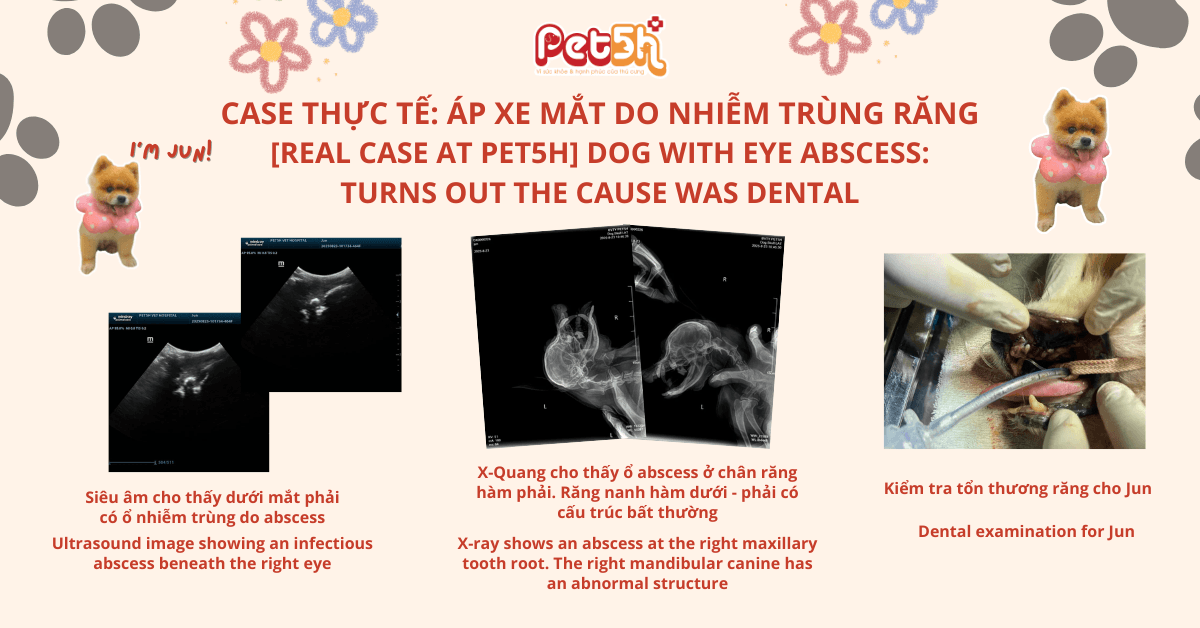
Diagnostic Imaging at Pet5H
Treatment Protocol at Pet5H
Abscess Management and Extraction of Damaged Teeth
Jun was placed under general anesthesia in a controlled and safe environment, with all vital signs continuously monitored. The veterinarian then proceeded to open the abscess, drain the purulent fluid, and remove all necrotic tissue to eliminate the source of infection completely. The severely damaged teeth-namely the upper right premolar (tooth 106) and the lower right canine (tooth 204)-were thoroughly extracted. In addition, the fistulous tracts connecting the dental sinuses to the eye and nasal cavity were cleaned and treated to prevent recurrent inflammation or the formation of new abscesses.
Antibiotic Therapy and Supportive Care
Based on the antibiogram results, Jun was prescribed a targeted antibiotic regimen with Enrofloxacin, combined with anti-inflammatory and analgesic medication as well as fluid therapy for systemic support. Post-surgery, he was closely monitored in the recovery unit to ensure stable respiration, circulation, and surgical site healing.
Treatment Outcome
Within just a few days, the purulent discharge from Jun’s eye had completely disappeared, and the episodes of sneezing and nosebleeds no longer recurred. Jun quickly regained his comfort, appetite, and playful energy as before. This recovery was not only a triumph of physical health but also brought immense relief and joy to his family after a long period of worry.
A Message for Pet Owners
When pets show unusual signs such as pus discharge from the eyes, frequent sneezing, or occasional nosebleeds, many owners often assume it is simply an eye infection or a common cold. In reality, the cause can be more complex, often stemming from dental disease or abnormalities in the sinuses. These hidden infections not only cause discomfort but can also silently affect a pet’s overall health. That is why regular dental check-ups are so important, as they help detect early problems in the teeth and allow timely treatment. Do not delay-take your pet to a trusted veterinary clinic for a thorough examination. A comprehensive check-up allows veterinarians to identify the true underlying cause and provide the most appropriate treatment plan. Only by addressing the root problem can pets recover quickly, remain healthy in the long term, and avoid recurrence.
A Note for Veterinarians
Jun’s case highlights the risk of misdiagnosis when relying solely on outward symptoms and personal experience, leading to “tunnel vision” that complicates treatment later. Initially, because of the ocular discharge, Jun was thought to have a blocked tear duct and underwent multiple abscess drainages, yet his condition persisted. In reality, the root cause lay in infected teeth that had formed fistulas connecting to the eye and nasal cavity. This reminds us that clinical evaluation should always be comprehensive, ensuring a broad perspective on the case. Accurate identification of the underlying cause enables definitive treatment, prevents recurrence, and ensures complete recovery for the patient.
Share
Facebook